
Last month, I spent a day in a room with 35 Learning & Development (L&D) and AI Enablement leaders wrestling with the same uncomfortable question: Why isn't AI adoption spreading the way we hoped?
Cameron Hedrick — former Chief Learning & Culture Officer at Citi — closed his keynote with a line that landed differently than most things I hear at events like this. Messy is fine. Iteration is key. Motion is the point. Something shifted in the room when he said it. Not the polite nodding that follows a good slide. It was recognition, maybe. And a bit of relief.
Most of these leaders had done everything right. Deployed tools. Launched training. Sent the communications. And adoption was still uneven, still fragile and ambiguous, still very hard to scale. Cameron's words named something they'd been carrying.
Three things from that day are still with me. Each one operates at a different level — the individual, the organization, and the culture. Together, they point to where the real work of AI adoption actually lives.
At the individual level: AI fluency looks nothing like technical training
During one of the afternoon activities, groups mapped their employees' tasks across two axes: routine versus novel, simple versus complex. What emerged wasn't a technology conversation. It was a deeply human one about judgment, communicating clearly under uncertainty, and knowing when to trust an output versus when to push back on it.
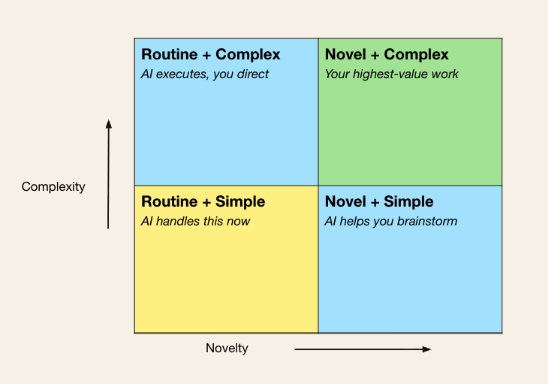
That conversation pointed to something most AI training programs get wrong. When organizations treat AI as a technical tool, they build curriculum around technical skills like prompt engineering, model architecture, and tool tutorials. The assumption is that understanding how AI works is what unlocks adoption. In practice, what actually determines whether someone uses AI effectively day-to-day has little to do with technical knowledge.
Using AI well is more a communication skill than a software skill. Nobody needs to understand how Zoom works to lead a productive conversation. The same logic applies here. What people need are the skills that make AI useful in the flow of real work: the ability to communicate clearly, to give useful feedback, to evaluate outputs critically, and to iterate when the first result misses. These are human skills that individual learners need to build in the context of AI adoption in their work, and L&D can help with curriculum that designs for that.
At the organizational level: L&D and AI Enablement need each other
When L&D and AI Enablement leaders completed our pre-event AI maturity assessment, they consistently rated their workforce's AI progress differently. AI Enablement leaders saw momentum. L&D leaders were more conservative in their assessment. Same organization. Different points of view.
That gap points to something worth taking seriously. AI Enablement leaders bring urgency, technology fluency, and a direct line to business outcomes. L&D leaders bring expertise in how people actually change — how to sequence learning, drive engagement, and design for behavior change at scale. Neither set of capabilities drives AI adoption alone.
I saw this at AB InBev. A leader working for the Chief Marketing Officer came to a capability-building role as a marketer — talented, ambitious, clear on the vision — but with limited background in learning design. Our L&D experts had the muscle to scale the work. The marketer had the domain knowledge and the organizational credibility to drive it. Neither could have gotten there without the other. That dynamic is exactly what's missing in most AI enablement efforts today: The people who understand the technology leading the direction, and the people who understand learning as the ones designing the experience.
At the cultural level: We are often alone with AI. And we shouldn't learn it that way.
The most powerful moment of the day happened between a group of people at a table during a breakout activity.
Their group had been asked to use AI to write a short story imagining what an assigned persona's work life might look like in 2030. Their first output was unconvincing, nothing like the real texture of the role. One person pushed back. Someone else suggested a different approach. They started passing the prompt around the table, arguing about the outputs, interjecting, refining together. By the end, they had something they were genuinely proud of.
L&D already knows how to build that kind of environment. Cohorts. Structured dialogue. Shared practice. These aren't new ideas. But in the context of AI adoption? They're the most powerful tools we have.
That moment captures what AI adoption looks like when it actually works. A colleague says, Wait, try it this way — and someone else is willing to. It becomes a shared experience. And actually, this has now been proven out to drive real change. Microsoft researchers studying 557 information workers found that peer influence was the single strongest driver of AI adoption, outperforming formal training and infrastructure. When AI learning stays private, it doesn't compound. Making it visible and social is what allows it to spread.
L&D already knows how to build that kind of environment. Cohorts. Structured dialogue. Shared practice. These aren't new ideas. But in the context of AI adoption? They're the most powerful tools we have.
Cameron was right. The leaders in that room were already moving — comparing notes, challenging assumptions, building something together in real time. The gap between AI access and AI outcomes is a human problem, playing out at every level of the organization. The people best positioned to close it are already in the room.