This is the first in on an ongoing series about leadership in the AI age.
Across the conversations I’ve been having lately with CEOs and CHROs about AI, a troubling pattern is emerging: Leaders are either failing to achieve near-term productivity gains or struggling to understand what the technology can deliver for their organizations over time.
It struck me that many leaders are being asked to make big decisions about AI without actually using AI themselves. At a recent executive gathering, for example, one C-suite leader went so far as to say that the impact of AI is completely “overblown” and “just hype.”
That’s what prompted me to act.
As CEOs, if we want our teams to understand what is coming, we have to create the space for ourselves, and for our people, to experience it directly.
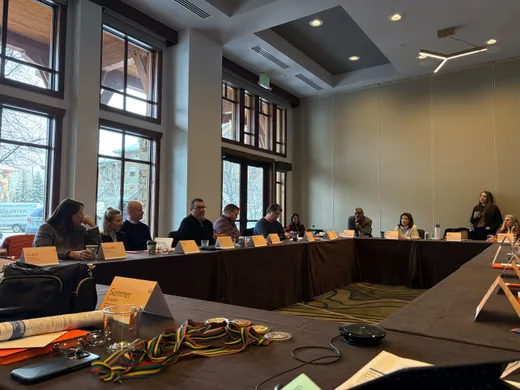
Last month, I gathered more than 50 Guild leaders for a mandatory, hands-on AI workshop. We built agents together, ran live experiments, and shared what worked and what didn’t in real time. My goal was to go beyond theory and into practice.
What became clear in that room is how different the conversation becomes once leaders have actually experienced the technology themselves. Too often, that firsthand exposure is missing. If you’re a CEO and you don’t experience AI firsthand, you are effectively making decisions in the dark about strategy, organizational design, capital allocation, and how work should actually get done.
As someone who learns the art of the possible by doing, I cannot imagine trying to reimagine a business with a tool I have not used myself. And I am not talking about casually prompting ChatGPT or Claude. You have to test, use, and see where the news models and tools break. That is how you develop a real understanding of both its power and its limitations.
Yet this is not how most organizations are approaching AI.
According to Deloitte, companies are spending roughly 93% of their AI budgets on tools but just 7% on supporting people through behavior change to drive sustained adoption. And based on my conversations in the field, many companies appear to be limiting themselves to only one, sometimes two, tools. And even then, they are not changing their workflows, behaviors, or decision-making.
Until that changes, AI-related gains will remain elusive.
Lowering the barrier to adoption
As CEOs, if we want our teams to understand what is coming, we have to create the space for ourselves, and for our people, to experience it directly. At Guild, we thought about what we could do to lower the barrier in our own organization, and we realized several conditions must be true:
If your employees have to ‘find time’ to learn AI, they won’t. And your strategy will stall. Employees need dedicated time and space to experiment. They cannot innovate if they are drowning in their current tasks.
If employees have to struggle alone, they will stop trying. I have realized firsthand how hard it is to stick with it without a community. When an API connector fails or a Claude Cowork won’t publish to Slack, employees need peers to help them troubleshoot. Without people to help you get unstuck, the frustration of wasting 40 minutes on a broken connector may cause an employee to abandon the effort entirely.
If you don’t build a culture of practice, don’t expect capability to follow. We must actively cultivate a desire to learn. Like learning a new sport, hitting the ball perfectly with a bat takes practice, discipline, and grit. It does not happen in the first swing. Ultimately, the organizations that win will be the ones that help their people keep learning and adapting, day in and day out.
If people can’t see how AI applies to their work, they won’t use it. People need to understand which tools solve specific problems. We need more use-case sharing within our organizations so employees can learn from one another. When organizations create these conditions, adoption starts to take hold. Among learners enrolled in our AI programs, 90% report using AI tools multiple times per week at work, and 78% say they feel more confident applying those tools in their day-to-day roles.
Among learners enrolled in our AI programs, 90% report using AI tools multiple times per week at work, and 78% say they feel more confident applying those tools in their day-to-day roles.
The danger of the single-tool mandate
This tendency to optimize for tools rather than capability shows up in another common mistake I’m seeing: Too many large organizations are restricting access to tools, locking their entire workforce into a single-vendor ecosystem. While this approach simplifies governance and reduces complexity for enterprise IT, it can also limit employees’ exposure to the broader AI ecosystem. And, over time, that may constrain their ability to adapt as the technology evolves. If a candidate interviewed with me today and told me they only knew how to use one AI tool, I probably wouldn't hire them.
For my part, my own stack is highly diverse. For example, I will often use NotebookLM to synthesize information, Claude Cowork to orchestrate tasks, Replit to allow for sharing, visibility and discovery, and ChatGPT to refine my writing because it does a great job of retaining my original thoughts and my unique voice.
By providing access to a diverse array of tools, we ensure our employees are prepared for roles that will be natively AI-driven. They will be able to move faster, and their discernment, judgment, and high-quality relationship-building will become even more differentiated and valuable.
Lead (and learn) by doing
As CEOs, we are navigating a massive, global economic transition. This is not a moment for passive advocacy. It is a moment for leadership by example. If we expect our organizations to adapt, we have to go first by learning the tools, changing how we work, and creating the conditions for others to do the same.
But this is just the beginning. In the rest of this series, Guild leaders will explore how AI is transforming their functions in real terms: What they’ve had to redesign, where experimentation has fallen short, and how they’re evolving workflows, processes, and behaviors to make AI work at scale.