
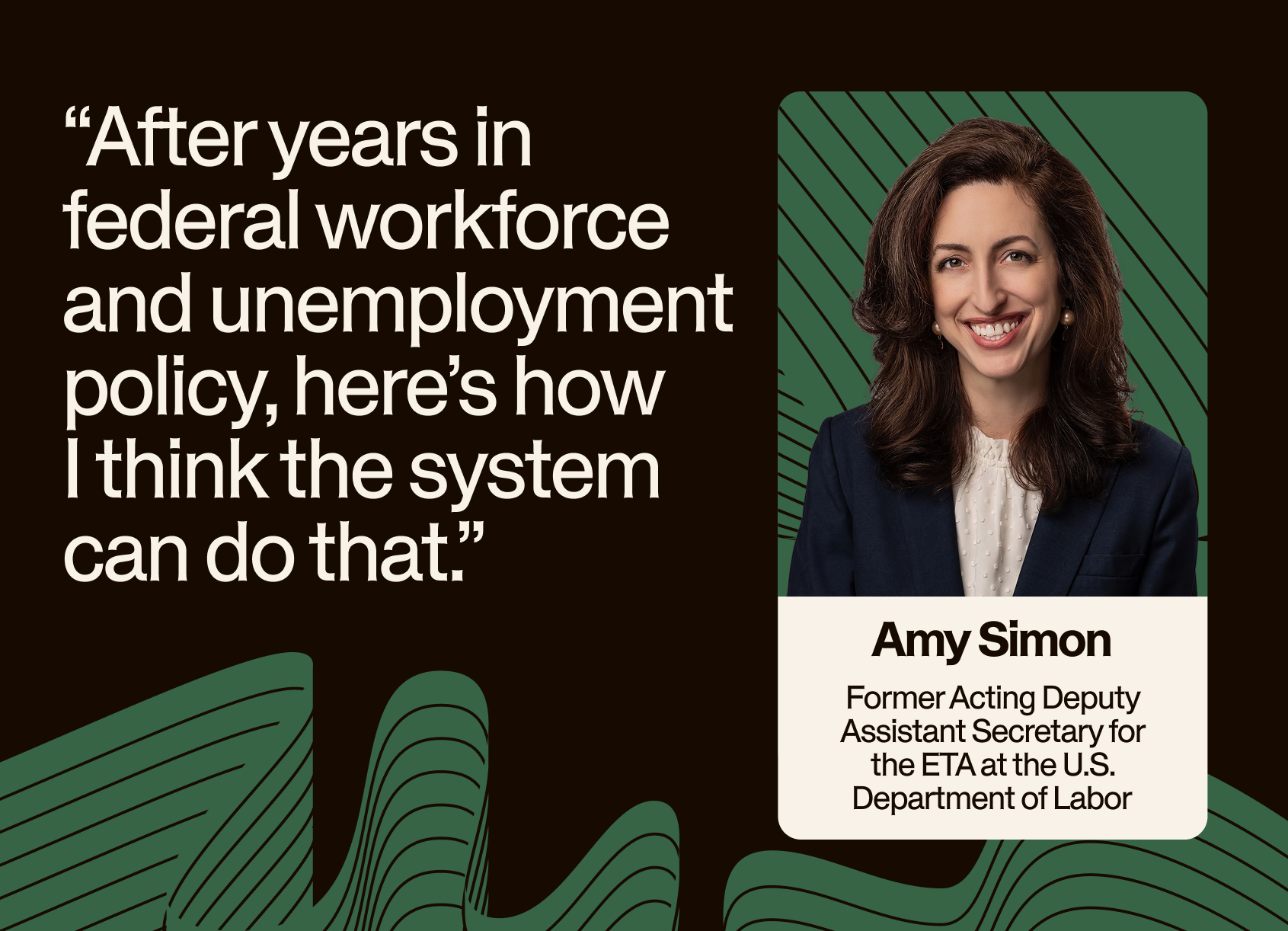
Meeting the AI Moment: The Case for Flexibility Over New Programs

Three ways the public workforce and unemployment insurance systems can adapt now, without waiting on new legislation.

Amy Simon|

The conversation about AI’s labor market impact is constant, speculative, and evolving as we see in practice, rather than in theory, where job loss and job creation land. There are already proposals for new income supports, or for retooling inefficient programs such as Trade Adjustment Assistance.

But what if the moment instead calls for flexibility, data-driven responsiveness, and aligned incentives in the existing infrastructure, rather than stapling on new programs? Here are three ways I think the public workforce and unemployment insurance systems can meet the moment.

First, acknowledge that many AI-exposed workers are distinct from the post-pandemic status quo populations in workforce and unemployment insurance programs.

In general, unemployment rates tend to be higher in production, transportation, service, and construction clusters, and lower in management and professional roles. As of July 2026, management and professional occupations stood at 2.9 percent against 5.2 percent in service work,1 and workers with a bachelor’s degree or higher at 2.7 percent.2 With initial claims near a four-week average of 204,000 and having not topped 260,000 initial claims in several years, the system is not yet seeing AI displacement at scale.3

A second troubling signal is worth watching: workers who lose jobs are taking longer to find new ones. The rate at which claimants exit unemployment insurance has flattened at about 11.7 percent, down from 15.2 percent in 2022, and the share exhausting benefits has more than doubled.4

If there were significant, long-term displacement of midcareer, higher-income workers, many state trust funds might be strained. Only 18 states met the recommended minimum solvency standard as of January 2026, down from 31 in early 2020.5 Higher-wage claimants are more likely to receive the maximum weekly benefit amount, so a shift in claimant profile could put pressure on state trust funds.

And although the public workforce system under the Workforce Innovation and Opportunity Act (WIOA) can serve anyone, its priority of service guidance first directs Adult formula funds to public assistance recipients, other low-income individuals, and those who are basic skills deficient.6 Dislocated Worker participants also tend to be older — 45 percent are over 45, against 24 percent of Adult participants — with median post-program earnings in the $30,000 to $40,000 range.7 This is not necessarily the profile of a highly-paid analyst whose job has been replaced by AI.

The workers most likely to be displaced by AI tend to be more educated and more highly paid than the traditional populations with higher unemployment rates,8 and tend not to meet the priority of service mandates that govern Adult formula funds.6 Some AI labor market impacts also seem to be falling on early career workers who have not yet successfully made the jump from education and training into initial labor market attachment.9

In short, many AI-exposed workers are not the typical unemployment insurance claimant nor the average WIOA participant. These systems were not built around the barriers they may face as entire industries transition, and it is not hard to imagine some of them falling through the patchwork between corporate outplacement, public safety nets, and private resources. Leaders should adapt systems in advance, not in reaction.

Second, embrace AI job creation that will likely coincide with AI displacement. During this transition period, prepping incumbent workers for change may be the most important investment.

AI is likely a double-edged labor market sword. Displacement is happening alongside AI adoption and heavy investment in AI infrastructure, with data center construction, for example, reaching a $61.9 billion annual rate in April 2026.10 Although the permanent employment that follows is currently modest — roughly 100 to 200 jobs per county – it reflects that displacement and creation likely occur in parallel.11

One of the most critical reasons for pre-displacement investment is preventing long-term unemployment. Workers who experience a long spell absorb lasting damage to their career prospects and likelihood of reemployment,12 and displacement carries well-documented consequences for physical and mental health.13 As unemployment drags on, workers become discouraged and exit the workforce entirely.

Waiting to react to AI displacement with post-employment reskilling is not beneficial to workers, employers, or the broader economy. The better approach would be to invest in incumbent workers most exposed to AI job loss, with AI literacy taught in job-relevant context rather than the abstract, and to create pathways into related occupations carrying less exposure. For example, healthcare workers participating in a Guild program were twice as likely to experience internal mobility and 50% less likely to leave their existing employers.16

Third, workforce and unemployment policymakers and private sector leaders should be creative in using existing flexibility. Labor force attachment should remain the key outcome measure.

On the policy front, the existing systems have numerous levers. Rapid Response is not only a post-layoff function; federal regulation explicitly authorizes layoff aversion, including funding incumbent worker training as part of that strategy.17 Governors may reserve up to 25 percent of the Dislocated Worker allotment for rapid response,18 and local areas may use up to 20 percent of combined Adult and Dislocated Worker funds for incumbent worker training — a cap the Secretary has waived to 50 percent in 2025.19 

In Oklahoma, Guild is supporting the state’s Talent Accelerator, launched in February 2026 with about $6 million in federal WIOA funding, which offsets up to 80 percent of employer training costs.21 The structure matters as much as the money: a state agency holding the funds, Guild as the operating layer focused on outcomes, employers contributing their own funds. ETA’s Reskill Dislocated Worker Grants are another good example of using an existing funding stream to provide flexible options.20

Dozens of states will have new governors next year, and they should all be fully aware of the flexibility and resources they have — in the Governor’s Reserve, Rapid Response, incumbent worker training authority, and RESEA — to address their state’s specific AI exposure and reskilling needs. 22

The north star of these investments should be worker outcomes, not the process or infrastructure for distributing funds. The goal is to equip workers for change, keep them attached to the labor force through disruption, and help more benefit from AI’s potential for job growth. That requires creativity and responsiveness from public and private sector leaders alike.

Guild is already showing what this outcomes-centric model can look like.

Footnotes

1. Bureau of Labor Statistics, Employment Situation, July 2026 (released August 7, 2026), https://www.bls.gov/web/empsit/cpseea30.pdf. Occupational rates are not seasonally adjusted; comparisons are year over year.

2. BLS, Employment Situation, Table A-4 (seasonally adjusted), https://www.bls.gov/news.release/empsit.t04.htm.

3. U.S. Department of Labor, Unemployment Insurance Weekly Claims, week ending August 15, 2026 (four-week moving average 204,000; advance initial claims 206,000), https://www.dol.gov/ui/data.pdf.

4. Federal Reserve Bank of Richmond, Economic Brief 26-24, July 2026, https://www.richmondfed.org/publications/research/economic_brief/2026/eb_26-24.

5. DOL/ETA, State Unemployment Insurance Trust Fund Solvency Report 2026, February 2026, https://oui.doleta.gov/unemploy/docs/trustFundSolvReport2026.pdf.

6. WIOA sec. 134(c)(3)(E), 29 U.S.C. § 3174(c)(3)(E); 20 C.F.R. § 680.610. On the separate veterans' priority, see 38 U.S.C. § 4215 and 20 C.F.R. § 680.650.

7. DOL/ETA, WIOA PY2024 Annual Summary Report, https://www.dol.gov/sites/dolgov/files/ETA/Performance/pdfs/PY2024/Annual%20Web%20Contents/PY2024_Annual_Summary_Report.pdf. WIOA median earnings is a quarterly measure defined at WIOA sec. 116(b)(2)(A)(i)(III).

8. Pew Research Center, "Which U.S. Workers Are More Exposed to AI on Their Jobs?" July 26, 2023, https://www.pewresearch.org/social-trends/2023/07/26/which-u-s-workers-are-more-exposed-to-ai-on-their-jobs/. Pew finds 27 percent of workers with a bachelor’s degree or higher are in the most-exposed jobs, against 12 percent of those with a high school diploma only, and that most-exposed workers earn about $33 an hour against $20 for the least exposed. Figures are from 2023 and predate the observed-usage exposure measures published since.

9. Brynjolfsson, Chandar, and Chen, "Canaries in the Coal Mine? Six Facts about the Recent Employment Effects of Artificial Intelligence," Stanford Digital Economy Lab, revised August 2026, https://digitaleconomy.stanford.edu/news/canariesaug26/. For contrasting findings, see The Budget Lab at Yale, https://budgetlab.yale.edu/research/evaluating-impact-ai-labor-market-novemberdecember-cps-update, and Brookings, "New data show no AI jobs apocalypse — for now," October 2025.

10. U.S. Census Bureau, Value of Construction Put in Place, detailed private seasonally adjusted table, April 2026 (data centers $61.9B SAAR against $45.4B for general office construction), https://www.census.gov/construction/c30/pdf/privsa.pdf. Figures reflect the annual benchmark revision published July 1, 2026, which restated April 2026 data center construction from the $50.7B originally reported on June 1, 2026.

11. Bahar and Wright, "New evidence on data center employment effects," Brookings, May 2026 (updated August 2026), https://www.brookings.edu/articles/new-evidence-on-data-center-employment-effects/.

12. Kroft, Lange, and Notowidigdo, "Duration Dependence and Labor Market Conditions: Evidence from a Field Experiment," Quarterly Journal of Economics 128(3), 2013; cf. Farber, Silverman, and von Wachter, "Factors Determining Callbacks to Job Applications by the Unemployed: An Audit Study," RSF Journal 3(3), 2017, which finds no duration gradient among college-educated women applying to administrative support roles.

13. Sullivan and von Wachter, "Job Displacement and Mortality: An Analysis Using Administrative Data," Quarterly Journal of Economics 124(3), 2009. Pennsylvania UI records matched to Social Security death records; the authors estimate a loss in life expectancy of about 1.5 years for a worker displaced at age 40. Sterud et al., "Mental health effects of unemployment and re-employment: a systematic review and meta-analysis of longitudinal studies," Occupational and Environmental Medicine, September 2025, https://pmc.ncbi.nlm.nih.gov/articles/PMC12505101/. GRADE certainty is rated low.

14. Fortson et al., "Providing Public Workforce Services to Job Seekers: 30-Month Impact Findings on the WIA Adult and Dislocated Worker Programs," Mathematica, May 2017, https://www.mathematica.org/publications/providing-public-workforce-services-to-job-seekers-30-month-impact-findings-on-the-wia-adult. The 20 percent figure is from survey data over 30 months; the 7 percent figure from administrative wage records over 36 months. On training, the authors write that "because differences across groups in rates of enrollment in training were small, our study produced inconclusive evidence on the impact of training."

15. Card, Kluve, and Weber, "What Works? A Meta Analysis of Recent Active Labor Market Program Evaluations," Journal of the European Economic Association 16(3), 2018.

16. Guild, " Amidst a Dire Workforce Shortage, Healthcare Systems Cut Contract Labor Costs and Close Talent Gaps by Investing in Internal Talent.” June 3, 2025. https://guild.com/news-press/amidst-a-dire-workforce-shortage-healthcare-systems-cut-contract-labor-costs-and-close-talent-gaps-by-investing-in-internal-talent.

17. 20 C.F.R. §§ 682.300(b), 682.320(b)(4). https://www.ecfr.gov/current/title-20/chapter-V/part-682/subpart-C/section-682.320.

18. WIOA sec. 133(a)(2), 29 U.S.C. § 3173(a)(2) (the Governor "shall reserve not more than 25 percent"). https://www.ecfr.gov/current/title-20/chapter-V/part-680/subpart-F/section-680.800.

19. 20 C.F.R. § 680.800; DOL/ETA Training and Employment Notice 25-24, May 6, 2025. https://www.ecfr.gov/current/title-20/chapter-V/part-680/subpart-F/section-680.800; https://www.dol.gov/sites/dolgov/files/ETA/advisories/TEN/2024/TEN%2025-24/TEN%2025-24.pdf.

20. DOL/ETA, Rapid Reskill Employment Recovery National Dislocated Worker Grants, TEGL 15-25, June 25, 2026; applications closed August 3, 2026. https://www.dol.gov/agencies/eta/dislocated-workers/grants/reskill-dwgs.

21. Oklahoma Employment Security Commission, Talent Accelerator announcements, February, July 23, and July 30, 2026, https://oklahoma.gov/oesc; see also Work Shift, "Public-private workforce training takes flight in Oklahoma."

22. Social Security Act sec. 306, 42 U.S.C. § 506; BRIDGE for Workers Act, Pub. L. 118-120 (Nov. 25, 2024); DOL/ETA TEGL 14-24 (June 10, 2025), which notes states have been permitted since FY 2020 to serve claimants in approved training. https://www.ssa.gov/OP_Home/ssact/title03/0306.htm; https://www.govinfo.gov/app/details/PLAW-118publ120; https://www.dol.gov/sites/dolgov/files/ETA/advisories/TEGL/2024/TEGL%2014-24/TEGL%2014-24(01).pdf.
About Amy Simon

Amy Simon previously served as acting Deputy Assistant Secretary for the Employment and Training Administration (ETA) at the U.S. Department of Labor, where she oversaw unemployment insurance policy. She currently serves as Vice President at LexisNexis Special Services, Inc.