Earlier this year, the Brookings Institute and GovAI published research identifying the occupations most exposed to AI, each with varying degrees of adaptability. Guild's enrollment data offers a real-time behavioral lens on the same question: Are workers in exposed occupations actually adapting? The answer, at least through the lens of learning, appears to be yes.
In April we showed which industries stood out in AI learning enrollment. This month we go deeper, past the industry level and into the specific occupations. To get there, we looked at occupational representation across two curriculum categories: “AI fundamentals” and “AI for leaders.” Why these two? Of the four AI curriculum types we track, we speculate these are the most anticipatory — programs workers reach for before AI is fully embedded in day-to-day workflows. Both could be early signals of where AI is going to creep in next.
One caveat worth carrying through: Exposure to AI is not the same as automation, and enrollment doesn't predict a timeline for disruption. But where workers are choosing to explore AI and plan for its implementation tells us something real about where they think it's headed and how they're choosing to respond.
The workers leaning in hardest have something in common
We focused on overrepresentation as the signal worth paying attention to here. That is, which jobs are showing up in AI program enrollments far more than their share of the overall learner population would predict.
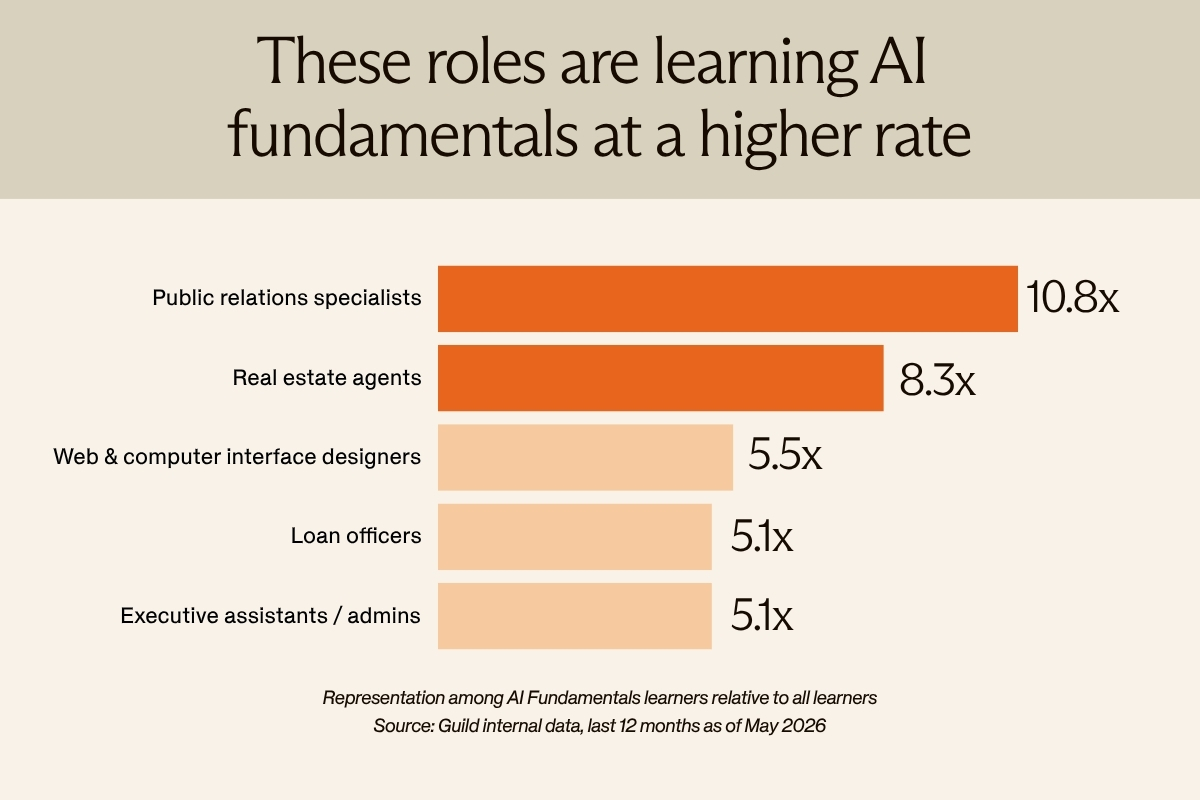
In AI fundamentals programs, the most overrepresented occupations include public relations specialists (10.8x), real estate agents (8.3x), web and computer interface designers (5.5x), and loan officers and executive assistants (both at 5.1x). Legal, computer and mathematical, and arts and media occupation groups lead.
One hypothesis: These may be roles where AI is already visibly transforming the core deliverable — not just how efficiently the work gets done, but what the work itself produces. In other words, tangible output is changing. A PR specialist's output is narrative. A loan officer's output is judgment applied to data. If that hypothesis is right, these workers aren't just leaning in to learn AI fundamentals out of curiosity. Even if they didn’t previously anticipate using AI or if they consider themselves non-technical, their changing work requires learning about it.
 Why this matters: Workers in these roles appear to be tracking AI's relevance to their specific work.
Managers are leaning in too, and sharing what they learn
Among learners in AI for leaders programs, we see something different. The most overrepresented roles include computer systems and information managers (8.6x), marketing managers (8.5x), purchasing managers (8.4x), and compensation and benefits managers (6.9x). Legal, computer and mathematical, and management groups lead.
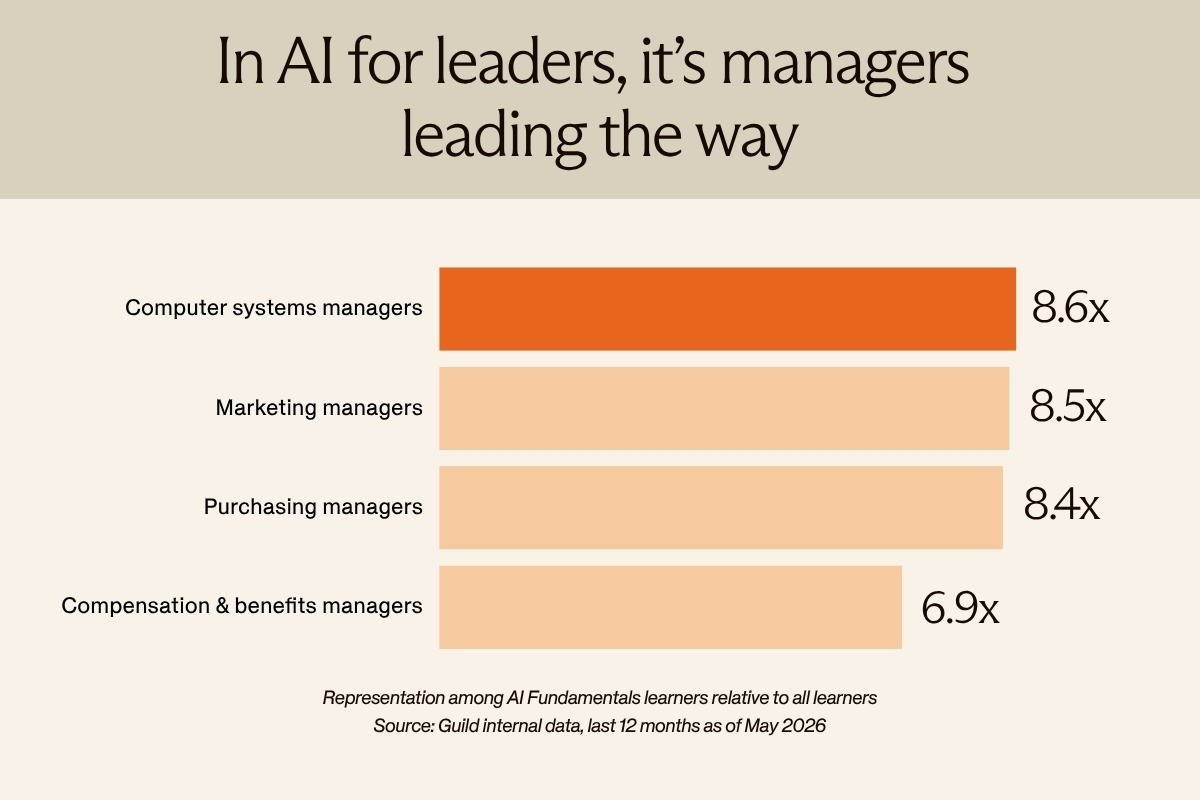 These may not be the people whose own output is most threatened by AI, but they have cross-functional scope; they’re learning AI to shape what it does to everyone else's roles. Guild's early learner survey data supports this directionally: Approximately 70% of AI for Leaders learners report using AI tools daily since enrolling, 57% have shared what they learned with their team, and 56% have used AI to solve a problem or produce something at work. Leadership learning may be a leading indicator of broader adoption and learning across the organization.
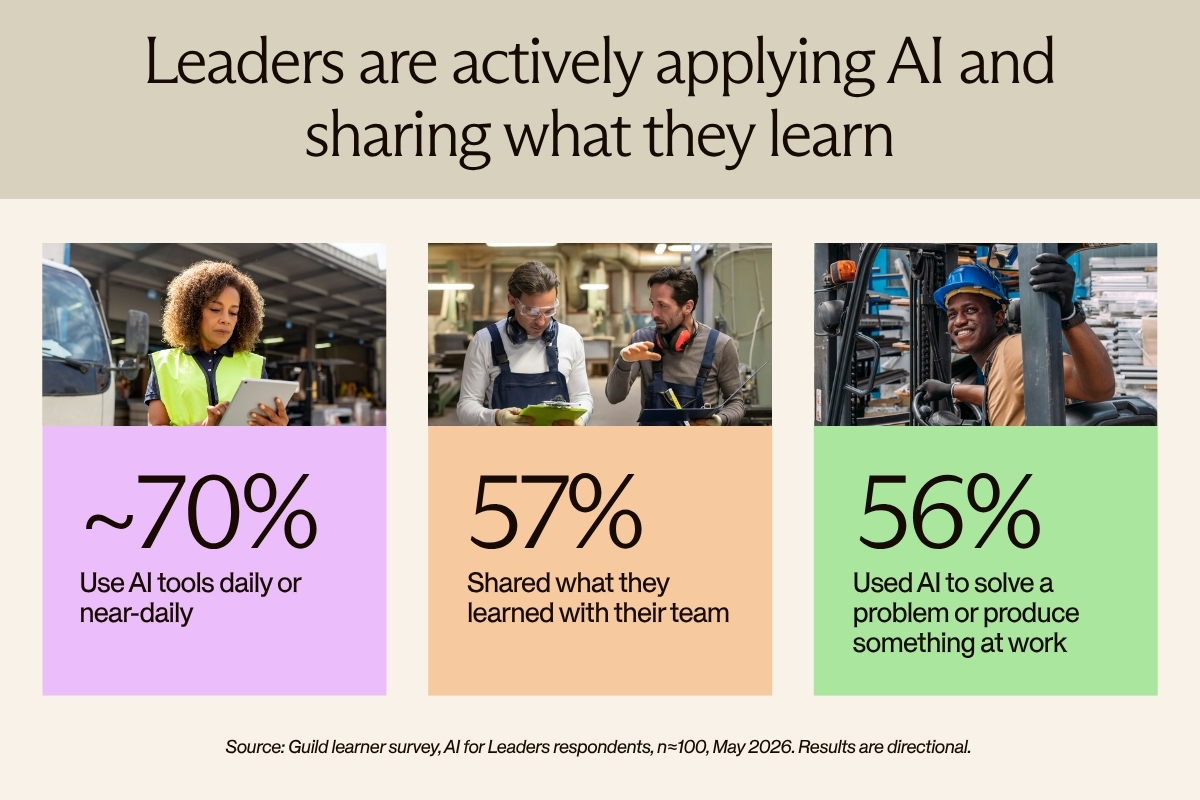 Why this matters: Managers appear to be learning AI to lead others through it.
The jobs where workers are not leaning in, and what that says about AI exposure
We shouldn’t forget the occupations least represented in both categories, because they delineate the boundaries of AI adoption in the near term. We looked at both categories of AI programs and found that underrepresented in each were building and grounds maintenance, food preparation and serving, healthcare support, and personal care and service, which are all predominantly hands-on, in-person roles where current AI tools have limited application to the actual work.
This confirms what we know about AI exposure in certain roles. It's a relevance gap that may narrow as AI tools evolve. We'll be watching for when the signal shifts.
Why this matters: The occupations not showing up are the ones where AI's near-term relevance is genuinely less clear. It’s useful information for employers thinking about where to sequence AI enablement investments.
Why this job-level data matters for workforce strategy
We chose AI fundamentals and AI for leaders curriculum for a reason. Together, the occupational patterns in these two categories offer a map of where AI is growing in relevance and starting to change behavior — at the individual job level and at the organizational decision-making level.
In AI fundamentals, it's individual contributors whose core deliverables AI appears to be changing first. In AI for leaders, it's the managers who may shape how broadly and how fast AI spreads across teams. If that hypothesis holds, these represent two ends of AI's organizational entry point. And workers in both groups are already in motion.
The occupation-level data asks a harder question than aggregate enrollment numbers: Are the right jobs in motion? Workers are already making bets on where AI is headed. The enrollment data makes those bets visible.
The signal: Workers know which jobs AI is coming for first and they're responding. The question is whether employers are moving at the same level of specificity.
Tracking enrollment by program type
In addition to our monthly topical briefs, the Guild Workforce Signal tracks enrollment by program type quarter over quarter.
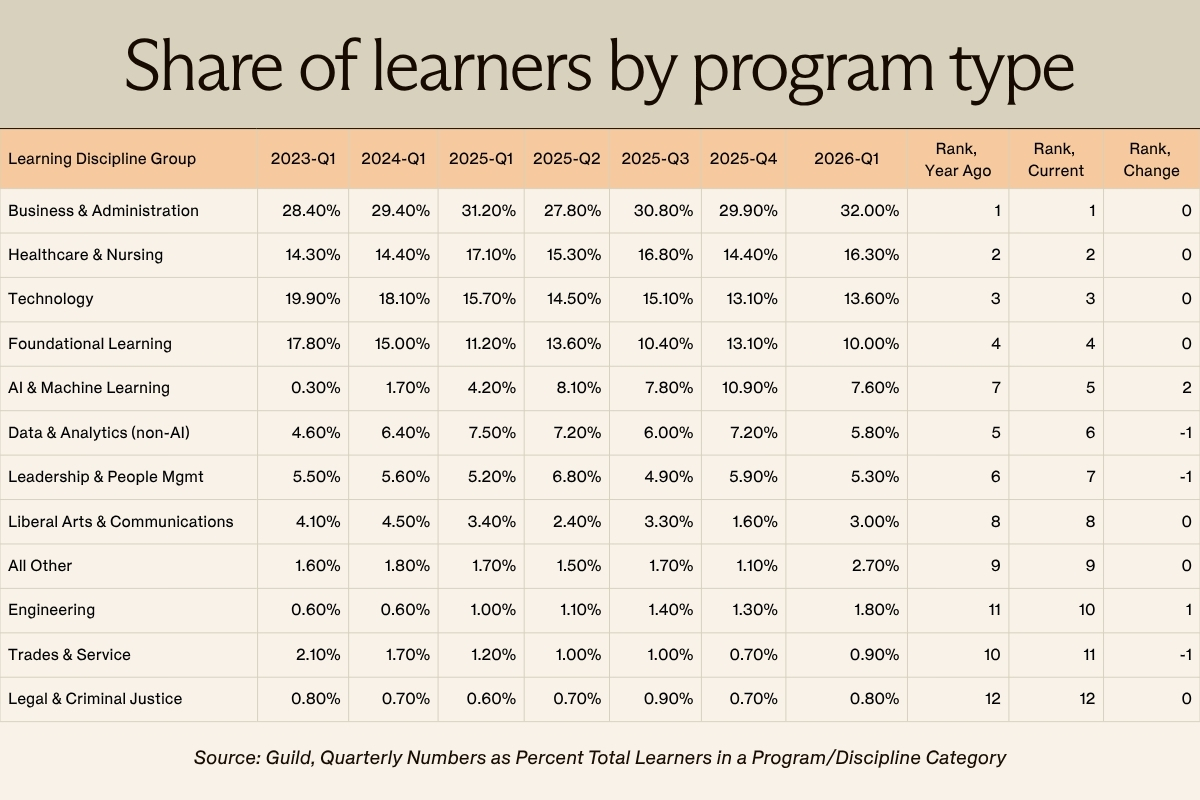 AI and machine learning enrollment dipped from 10.9% in Q4 2025 to 7.6% in Q1 2026, though it remains well above the 4.2% recorded in Q1 2025. Whether Q4 represents an actual adoption peak or seasonal fluctuation, we'll continue to watch. Healthcare and nursing programs rose from 14.4% to 16.3% quarter over quarter — a signal we'll dig into in a future month.