
Over the past decade, concern about rural "left behind" areas has moved from academic conferences into the mainstream press and policy debate. In 2017, the Wall Street Journal drew a pointed comparison between struggling rural communities and the urban decline once associated with America's inner cities, and researchers at the Economic Innovation Group have since documented just how real that gap is, identifying over 1,000 U.S. counties, home to nearly a fifth of the population, that have persistently lagged behind the rest of the country on jobs and income growth.
The detrimental cycle is familiar: young people leave rural communities for economic opportunities in urban areas, increasing the population’s average age and reducing tax revenues needed to sustain essential services like education and healthcare. It’s a feedback loop where today’s departures fuel tomorrow’s community decline.
But the picture is more complex than that. Yes, some rural states genuinely face a departing young workforce. Yet, interestingly, others have become significant attractors of young people — especially young college graduates — over the past five to six years. This edition of the Workforce Signal explores what separates these two groups, and what it means for how states invest in workforce training.
Some rural states are winning the war for young talent
We used two datasets: the Census Bureau's American Community Survey (2024 5-year sample)1 and Guild's proprietary data on what skills people are learning. We sliced states along two dimensions: how rural each state is, and the net migration of young, college-educated adults (ages 22-34, excluding students).
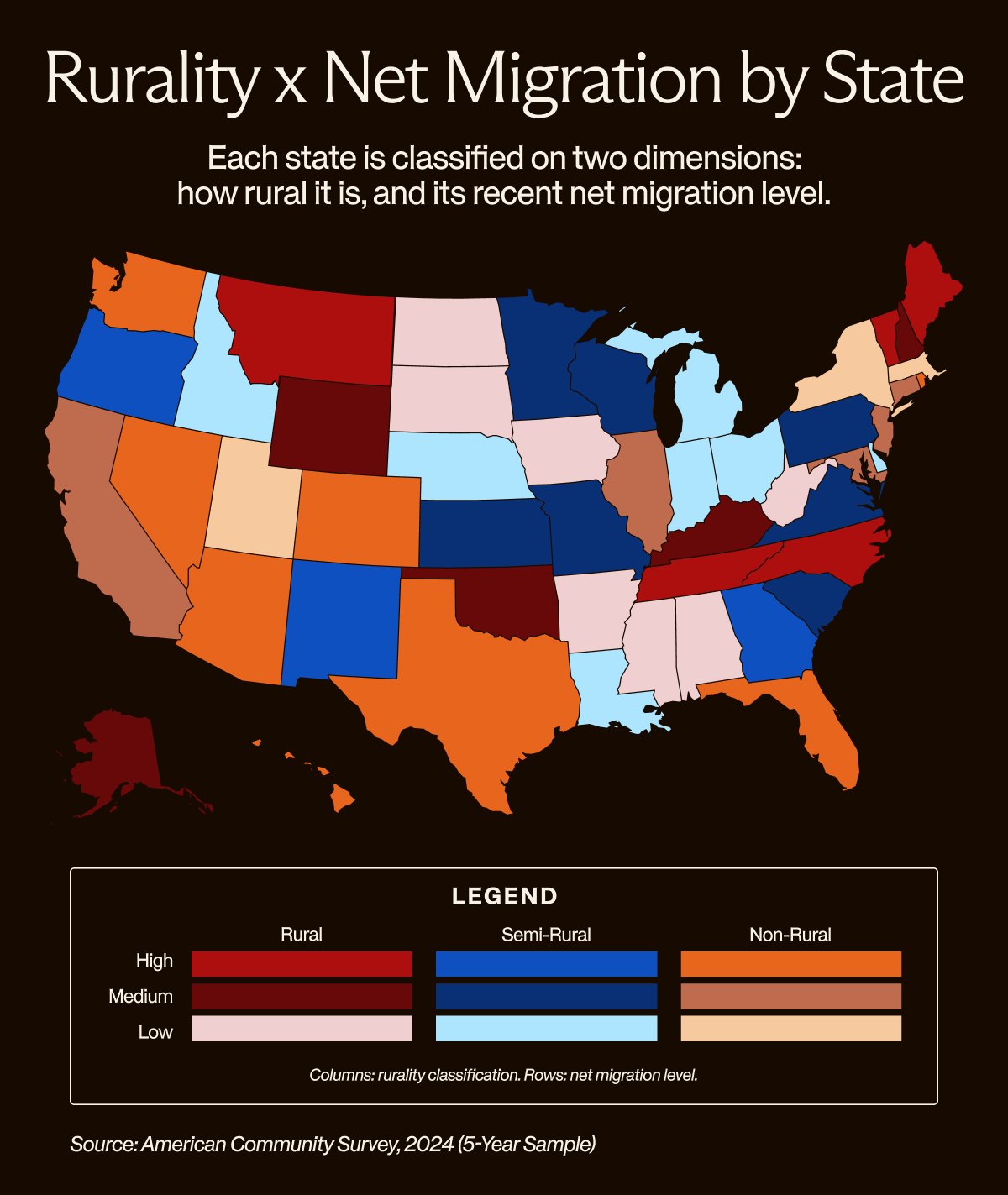
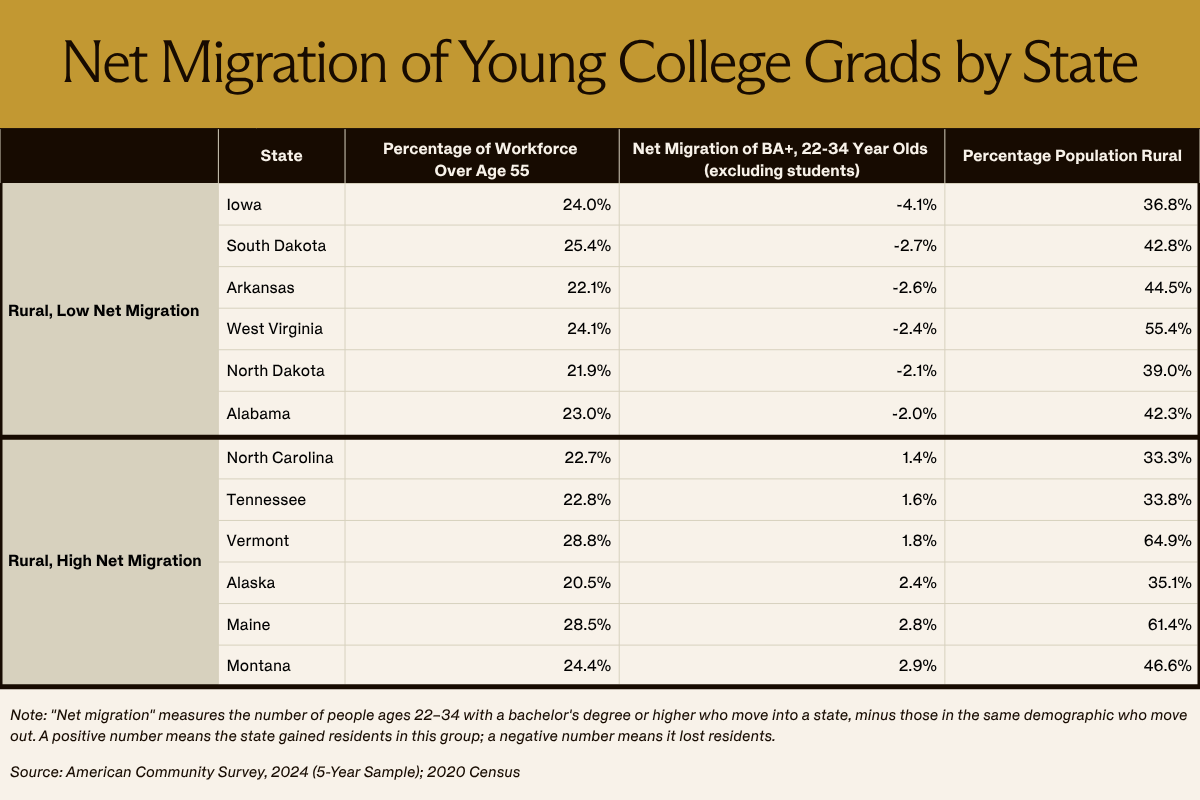
Despite the common misperception, many rural states are quite good at attracting young, educated people, even states that skew older than average. Vermont, Maine, and Montana are all highly rural, older than average, and still strong attractors of college-educated talent. South Dakota and Arkansas show the opposite pattern: a relative abundance of young workers today, but difficulty keeping them from leaving.
The skills divide: logistics vs. office work
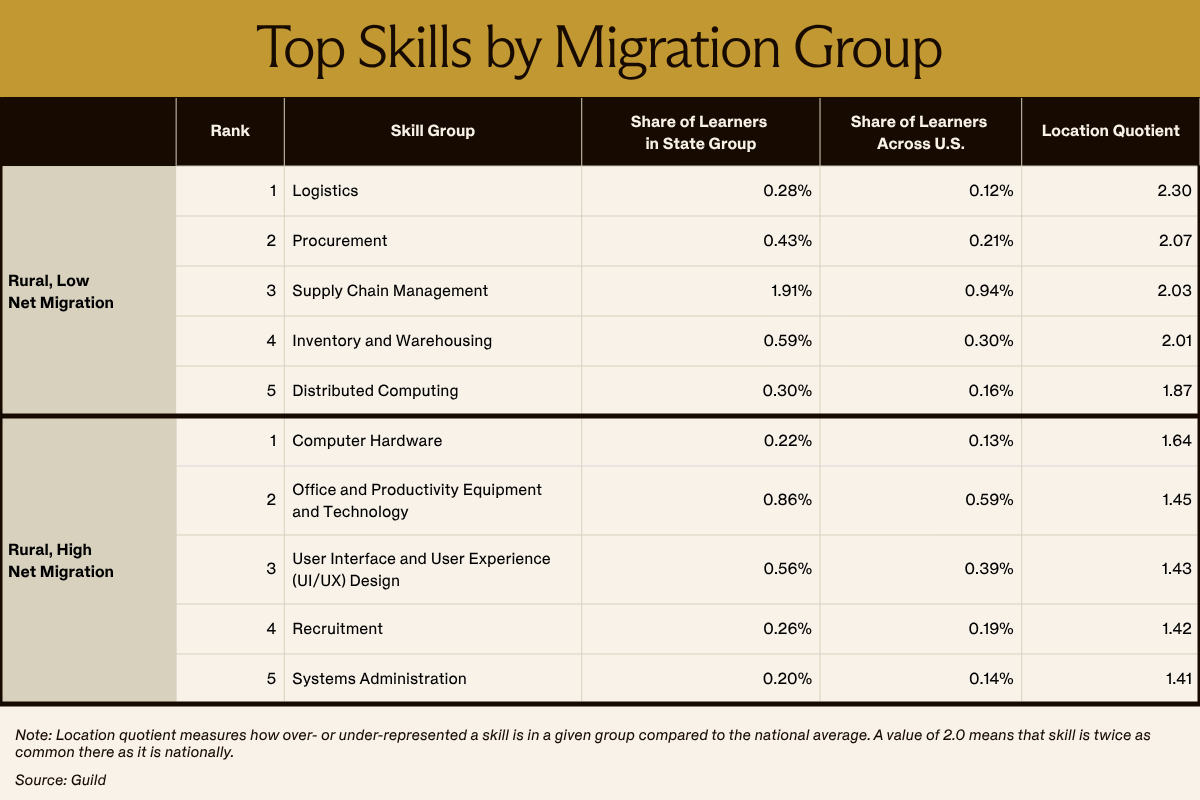
We looked at employer-sponsored upskilling trends among Guild learners to see how these two groups of states (low-migration rural and high-migration rural) are adapting to the labor markets around them. The two groups' top skills diverge in kind: low-migration states cluster around logistics and supply chain, high-migration states around office and technical work. One possible explanation for the latter: remote workers choosing to live in non-urban areas while keeping office-based jobs. For North Carolina and Tennessee specifically, the pull of nearby metros like Charlotte and Nashville may also be a factor, though we can't confirm either theory with this data alone.
Four states, four different stories
To see these patterns up close, we zoomed into four states that illustrate the range: two rural states losing young talent (Arkansas, South Dakota), and two winning it (Vermont, Montana). The migration data behind all four is solid; the skills data varies in strength state to state, as noted below.
Arkansas — Young, rural, and losing talent (-2.6% net migration), Arkansas’s workforce has a strong concentration of logistics and supply chain skills, reflecting the state’s large distribution and freight industries, as well as its substantial agricultural and poultry production. It's the clearest case of a training pipeline mirroring a dominant industry.
South Dakota —Also losing young talent (-2.7% net migration), South Dakota became a nationally recognized banking hub after adopting flexible financial regulations in the 1980s. Today, learners are increasingly building technology and data skills as the financial industry shifts toward digital finance, or fintech.
Vermont — One of the strongest rural attractors of young, educated migrants in the country (+1.8% net migration, 65% rural), Vermont's workforce leans toward design and technical skills. Guild's own learner sample is relatively small here, but it's consistent with the broader high-migration pattern.
Montana — Older than average yet a strong young-talent magnet (+2.9% net migration), Montana doesn't show one dominant set of skills the way Arkansas does. Its skills data is spread across many categories rather than concentrated in one specialization. It's a reminder that attracting young talent doesn't require a single specialization.
The lever states actually control
Migration patterns are not entirely in a state's control. People move for all kinds of reasons, however, a workforce strategy built around growing industries and employers' in-demand roles can support positive net migration and a state's overall economic health.
For example, a state can control is what its existing and newly arriving workforce is being trained to do, and the right approach differs by group. Older, low-migration states like South Dakota have room to reskill late-career workers into growth sectors — healthcare chief among them. As we explored in a recent Workforce Signal edition, healthcare has driven most U.S. job growth over the past three years, and its hands-on nature makes it more resistant to AI disruption than most office-based work — a durable landing spot for later-career reskilling. States could also encourage workers nearing retirement to stay a little longer. That approach may help even in older, high-migration states like Vermont. Its workforce is old enough that incoming young talent alone won't fully close the gap. Younger, low-migration states like Arkansas face a different opportunity: training young workers for hands-on production roles — manufacturing, transportation and warehousing, health care — that are already experiencing local shortages. There's already a foundation to build on: across Guild's industrial-sector learners nationally, 54% are ages 20-34, compared to a 29% industry-wide average. Making these career pathways more visible, and tied more clearly to employer demand, could give young workers stronger reason to build careers close to home. In the best case, successful reskilling here does double duty, improving both job readiness and long-run retention.
This kind of alignment is already happening. Oklahoma, for example, has invested heavily in building high-demand training pipelines, including a new statewide accelerator connecting employers to skills training in aerospace and defense, advanced manufacturing, and AI infrastructure. Other states are reaching similar conclusions. For example, Indiana is supporting the development of skilled talent in key industries and measuring public training programs by whether they actually lead to opportunity.
The Signal: One size doesn't fit all for rural states. Some are losing young talent, others are gaining it, and at the group level, their workers are learning meaningfully different skills as a result. Migration itself is influenced by many factors, but what a state trains its workforce to do can attract new opportunities for business growth and in turn meaningfully shape the economic resilience of states’ citizens. The specific tactics will look different state to state, and the data here is a starting point for that conversation.
1 using data from the 2024 ACS survey, the last year for which complete, verified data is available