If you've been reading the jobs reports lately and wondering where all the hiring went, I have one word for you: healthcare.
According to the Bureau of Labor Statistics (BLS), 51% of all U.S. job growth over the past three years has come from this sector. In just the past year, that share climbed to a striking 85%. That's been enough to lift the healthcare industry's share of overall employment from 10.8% in June 2023 to 11.6% in June 2026.
Demand is growing at the same time healthcare's workforce pipelines are constrained. As of 2024, 18.1% of healthcare workers are foreign-born, a population facing well-documented immigration headwinds — headwinds that turned more concrete this month, as for example Temporary Protected Status expirations for workers from Haiti and several other countries drew warnings from healthcare leaders that an already-strained workforce could shrink further. In addition, the workforce is also modestly older than the labor force overall — median age 42.4 in healthcare vs. 42.1, which means a sooner retirement cliff for healthcare workers.
Guild's Talent Resilience Index, published late last year, had a similar observation: These healthcare roles are resilient and rising in demand, but without a sufficient supply of trained individuals in the workforce, filling critical roles keeps getting harder.
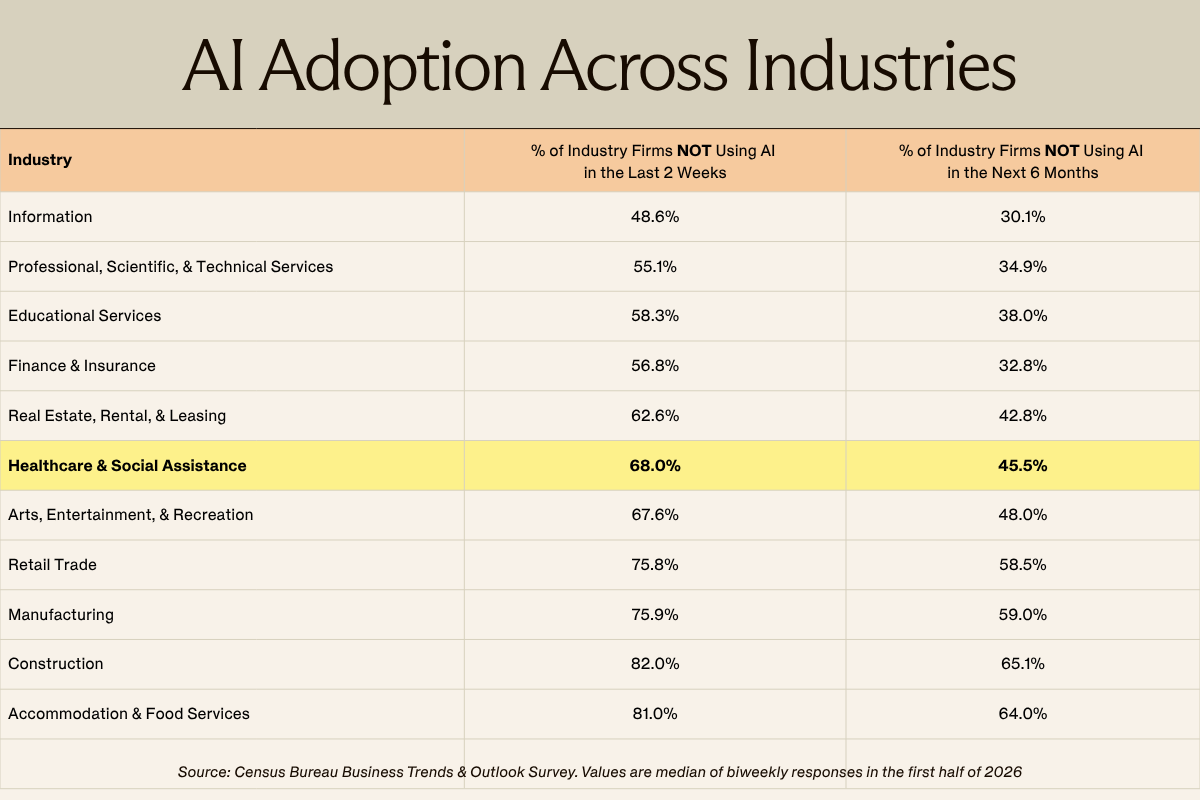
It's not just the supply side that makes healthcare worth watching right now; the nature of the work itself sets it apart, too. Healthcare has a structural advantage as the labor market enters a period of AI-driven disruption: The work is fundamentally hands-on and relational, delivered in person, by people, to people. That's a harder thing for AI to substitute for than the kind of white-collar, screen-based work it's already reshaping. The adoption data bears this out — Census data show 68.0% of healthcare & social assistance firms aren't currently using AI, and 45.5% don't expect to in the next six months, notably higher than in office-centric sectors like finance & insurance (56.8%; 32.8%) or information services (48.6%; 30.1%).
That gap looks less like reluctance and more like a reasonable reflection of what the work actually requires. Even as adoption rises over time, AI is far more likely to augment clinical work than replace it. For workers watching automation reshape other parts of the economy, that may make healthcare look like a comparatively durable bet.
For workers watching automation reshape other parts of the economy, that may make healthcare look like a comparatively durable bet.
Healthcare roles, though, often require specialized education and credentials, which raises the obvious question of whether the pipeline into the sector is keeping pace with demand. Taken together, these two dynamics — a workforce under real strain, and a sector positioned to hold up better than most against AI disruption — point to a genuine opportunity for workers. That's the backdrop for this month's enrollment data.
Learners are showing up for healthcare in growing numbers
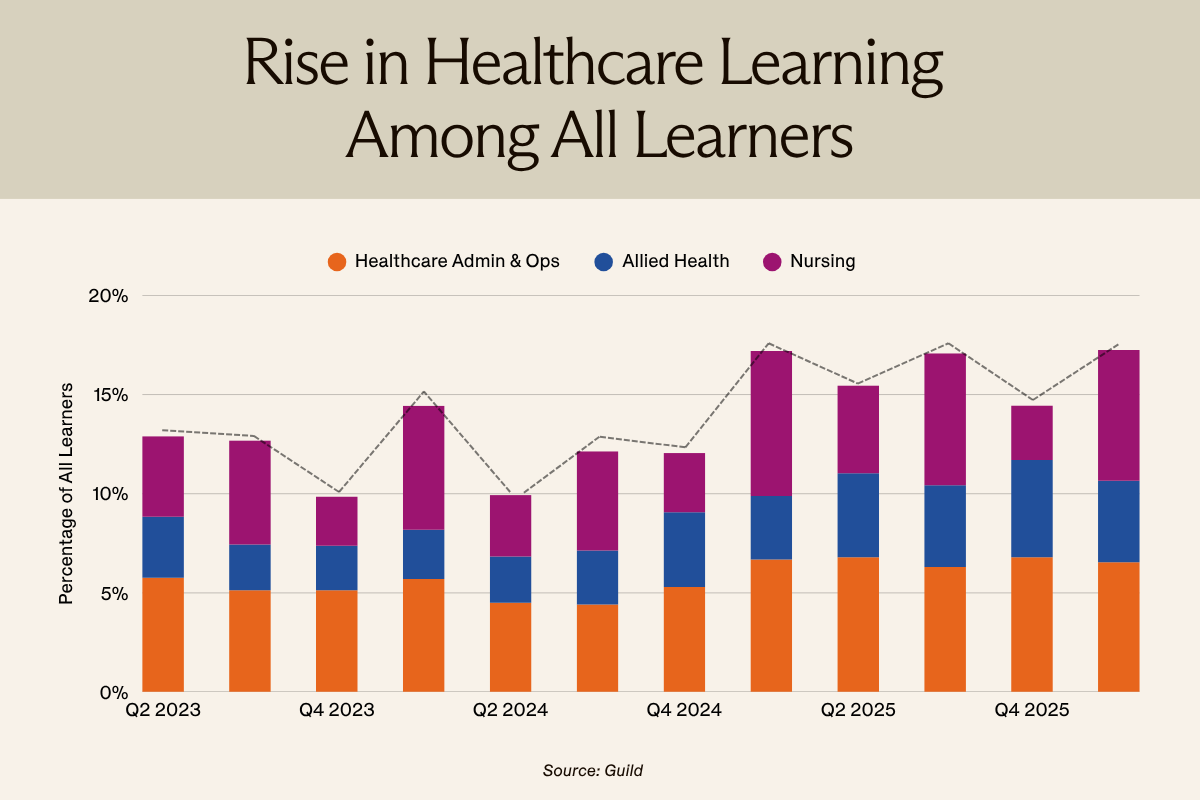
Enrollment in healthcare curricula has risen sharply: 16.2% of Guild learners per quarter enrolled in a healthcare curriculum in Q2 2025–Q1 2026, up from 12.7% over the same period a year earlier. That's a broad-based increase, driven mostly by workers already in healthcare investing further in the field.
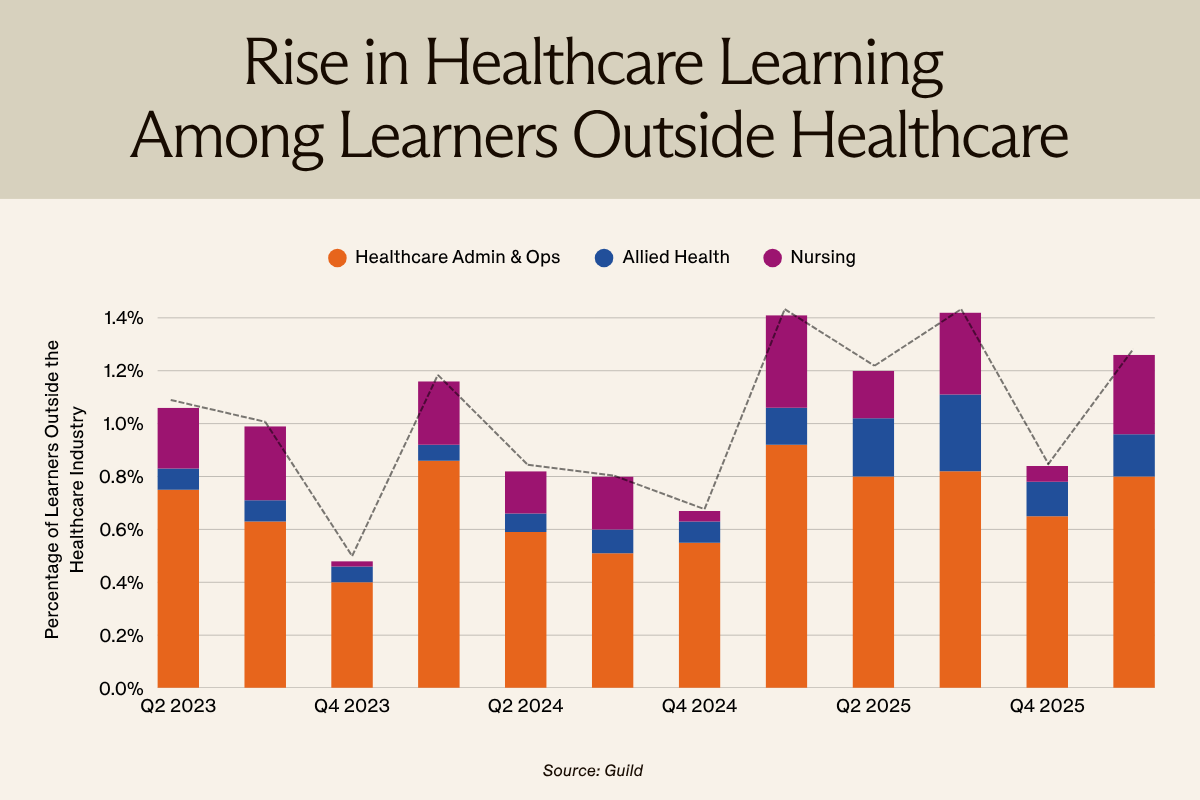
There's a smaller but notable signal running alongside it: Among learners who changed employers within Guild's network, those who left another industry for healthcare outnumbered those who left healthcare by 2.2 to 1. And the share of healthcare enrollment coming from learners outside the industry ticked up too, from 0.9% to 1.2%. These are still small numbers in absolute terms (outside-industry learners remain a sliver of total healthcare enrollment). But the direction is consistent: Even people with no current foothold in healthcare are increasingly choosing to study toward it.
Where the growth is concentrated
Among all healthcare learners, the increase is concentrated in two categories: healthcare administration & operations (5.1% → 6.6%) and allied health (2.9% → 4.3%). The latter involves hands-on clinical training, such as pharmacy, clinical/medical assistant, phlebotomy, sterile processing.
These same two categories also account for most of the increase among learners coming from outside healthcare. In other words, to the extent education is functioning as an on-ramp into the sector, we’ve seen both non-clinical (healthcare admin/ops) and clinical (allied health) pathways strengthen.
Anecdotally, we've seen this play out on the ground: Guild learners already working in healthcare have used these programs to step into new roles. A biology grad unsure where her degree would lead spent several years as a care coordinator, then used her benefit to pursue a BSN and move into nursing. A patient registrar decided she wanted more hands-on clinical work, became a medical assistant through Guild, and is now eyeing an RN path next. Both learners are moving deeper into healthcare.
The Signal: Healthcare's growth is outrunning most other sectors' by a wide margin, its traditional workforce pipeline is under real strain, and the nature of the work itself may make it look like a rare durable bet in an AI-disrupted labor market. Guild's enrollment data shows learners responding in step, with meaningful growth in both clinical and administrative pathways into the field. In coming editions, we'll look at enrollment data from a geographic lens.