
I started my career as a recruiter at a company called Trilogy Software, employee 146. On my first day, they handed me a binder everyone called “the Bible.” It was everything you'd need to know, logistically, to do the job. Part of that job included recruiting at Harvard, where interviews happened in hotel rooms. What time to book, how many, which hotel — all laid out in that binder’s sacred text.
What the binder didn't say: Make your bed first. Nobody had thought to write that down. It took a few hotel rooms with 22-year-old recruiters interviewing candidates next to unmade beds for someone to explain, out loud, that this was a problem.
In my case, I knew to make the bed because I'd shadowed the recruiters before me. I watched them do it. I role-played it a dozen times before I did it for real. The binder taught me the instructions. Watching other people taught me the judgment.
That's the distinction I want to make: Knowledge transfer is not the same as knowledge context. One hands you information. The other is what actually builds judgment. There's mounting evidence that we're underinvesting in the judgement piece right now.
Transferring knowledge was never the hard part. We have a hundred tools for that now, and AI is happy to take it off our plates entirely. The hard part is knowing how and why it matters now, and that only comes from doing the reps, in front of other people, close enough to watch each other mess up and learn from it. AI can hand you knowledge instantly, but it wasn’t earned. And earning almost never happens in isolation.
We didn't lose apprenticeship on purpose. We lost the space for it.
Before COVID, apprenticeship (really any on-the-job learning) happened by osmosis. You were physically present when someone more experienced handled something, and you absorbed it just by being nearby. Now when a question comes up, the fastest path isn't finding the person who's done the thing. It's asking a chatbot. I'm not against the shortcut existing. I'm against it being the main thing replacing learning with and from other people.
You know what happens when you microwave something? The outside warms in a minute, and the middle stays cold. That’s the price of an instant answer — surface-level transfer, without the depth of something actually earned.
Consider cohort learning as a modern replacement.
This is where I see cohort-based learning as a modern replacement for what's being microwaved. It’s actually why I signed on to be an advisor for Guild Academy this year.
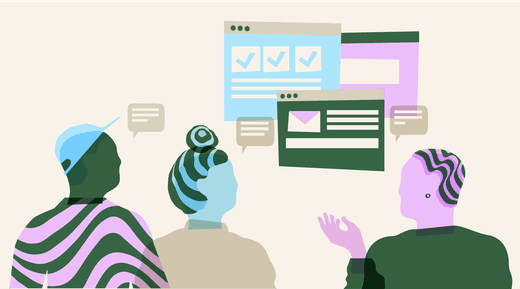
Calling a cohort a way to "bring people together" undersells it. It's one of the few structures built to recreate what apprenticeship gave us: people encountering the same real problem, close enough to watch each other think it through.
I've seen this happen by accident, long before anyone called it a cohort experience.
For example, at one company, our leader left, and for months we ran ourselves. Everyone assumed disaster, but it was the opposite. Before, a decision went up to the boss and came back down buttoned up, with no visibility into how. Without that boss, we made decisions with each other. I got access to how everyone else actually thought — the same way a mentor's judgment used to become visible to an apprentice watching them work. That was more of an accident than an intentional program. Cohort learning is the same principle – learning together – on purpose.
You know what happens when you microwave something? The outside warms in a minute, and the middle stays cold. That’s the price of an instant answer — surface-level transfer, without the depth of something actually earned.
People don’t need to be in the same room at the same time to get these results either. They just need to be in front of the same real problem, in a given window of time, to react to each other and trade ideas. That's a different bar than physical proximity and more achievable in busy, distributed workplaces.
All of this is, notably, not something AI can substitute for. I’ve seen a transcript of an AI coach advising someone to just ignore a strained relationship with their boss and move on. But a sycophantic agent designed to keep you happy can’t tell you what you don’t want to hear, and that’s exactly where judgment comes from. A peer in a cohort, moving through friction and discussing the same real problem with you, can.
Not every cohort-based learning experience does this. In fact, most don't. A lot of them are content delivery with a Slack channel added on. What makes the difference is whether the interactions are authentic, whether people keep coming back to the conversation, and whether that conversation is rooted in the real context of the business. Those are the conditions that make cohort learning a genuinely great way to build internal connection and judgment.
So how do you know a shared learning experience recreates what apprenticeship used to give us?
My litmus test: Check the group chat. I finished a cohort program recently where the chat stayed alive the whole time, with people showing up for each other. I learned as much in group discussions as I learned from the coursework itself. But then we graduated into a general alumni channel, and never spoke again. Whatever intimacy had formed was killed the moment it got replaced with something bigger and more generic.
That's the real tell, not completion rates, but whether the conversation kept going after nobody was making anyone show up. Engineer the logistics for efficiency all you want. Just don't engineer out the chemistry. It's the foundation for social learning that changes how people think and work.
In a world where knowledge is a commodity now — when it’s everywhere and instantaneous — what's rare is the earning of it. That was always a group activity, even when we didn't notice the group. Cohort learning is one of the few structures that gives it back.
You can microwave information. You cannot microwave apprenticeship. The outside may look done, but the middle will still be cold.