Ten years ago, researchers at University College London ran an experiment that revealed something telling about our relationship with uncertainty.
In the experiment, participants played a computer game while occasionally receiving mild electric shocks. Researchers varied how predictable those shocks were and monitored the patients’ stress responses. They discovered that the people who experienced the highest stress levels were not the people who received a shock with 100% predictability. Instead, the people who were most stressed were those who had roughly a 50% chance of receiving a shock.
Knowing what’s coming, even when unpleasant, was less stressful than wondering what might happen.
Author Simone Stolzoff brought this insight to the stage at Guild’s 2026 Opportunity Summit to illustrate a problem we’re becoming increasingly ill-equipped to handle. Uncertainty is growing at the exact moment our tolerance for it seems to be decreasing.
We’ve come to expect quick answers. We carry devices that can give us information in seconds, and AI has made that information even more immediate. Yet at the same time, due in no small part to the same technology, it’s never been harder to predict the future of work.
Stolzoff offered another way to look at the problem. A predictable future doesn’t leave much room to shape it. That same uncertainty that makes us uncomfortable also means we have an opportunity to influence what happens next.
The challenge for leaders now is how to exercise that influence. Here are three lessons that emerged about building adaptability.
1. Confidence in workforce readiness may be a warning sign.
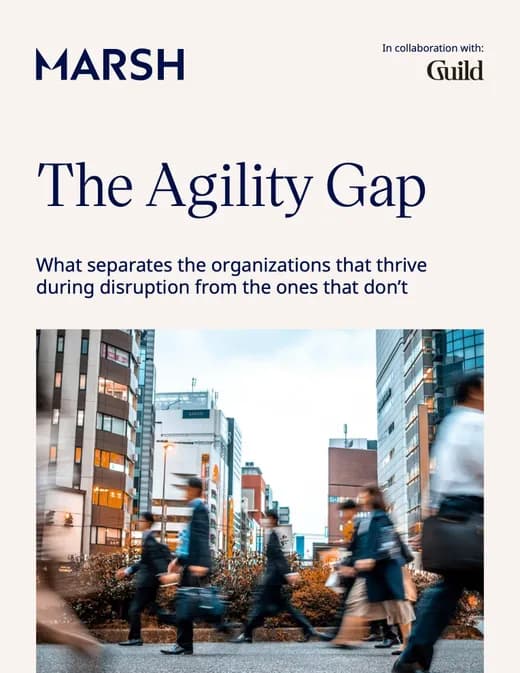
According to The Agility Gap, a new report from Marsh (formerly Mercer) in collaboration with Guild, companies experiencing stronger growth are less confident in their workforce agility than their slower-growing peers. According to research from Marsh, just 57% of high-growth organizations believe their workforce models are sufficiently agile, compared with 70% of low-growth organizations.
Low-growth companies 70%
say their workforce models are sufficiently agile
High-growth companies 57%
say the same
Source: Marsh Global Talent Trends, 2026, as presented in The Agility Gap. Growth refers to business growth, not headcount.
This suggests that the organizations doing the most to adapt are also the ones most aware of how much work remains.
At Opportunity Summit, Margaret Busse, co-chair of Utah’s Pro-Human AI Initiative, questioned our reliance on retrospective labor market data to anticipate how AI will reshape work. Historical data is important in showing where demand has risen or fallen but becomes a less reliable guide when the nature of jobs is changing faster than established patterns can capture.
Ultimately, that calls for a more responsive approach to workforce strategy.
Look beyond historical demand. Combine labor market data with emerging signals from business priorities, technology adoption, and changing workflows.
Invest in learning agility. Tammy Thieman, Director of Career Choice at Amazon, pointed to the growing importance of developing employees' capacity to adapt as roles evolve. “The thing that's becoming most valuable is learning agility,” she said.
Make plans easier to revise. Invest in workforce initiatives that allow for flexibility and evolution as needs change.
Build learning into decision-making. Use targeted experiments to test assumptions before committing to a large-scale approach.
2. Redeployment and internal mobility are core capabilities for an adaptable workforce.
When AI changes a role, what happens to the person doing it?
The Agility Gap highlights 65% of organizations expect at least one-fifth of their jobs to require reskilling or redeployment due to AI within the next two years.
Yet most employers have far more established processes for bringing people into the business than for moving existing employees into substantially different work.
At Opportunity Summit, UCHealth President and CEO Liz Concordia described how the health system’s Ascend program is helping employees prepare for new clinical careers. But UCHealth also recognized that paying for education wasn’t enough. The organization needed to help qualified graduates move into relevant openings across departments, connecting its investment in employees with its own critical staffing needs.
“We made sure that when those folks graduated, that we had people that would hire them,” Concordia explained. That required working across departments to connect newly qualified employees with relevant openings, including opportunities to move from outpatient settings into inpatient nursing roles, ensuring internal mobility became an outcome of its workforce investment.
Make existing capabilities visible. Understand employees' skills and experience beyond the jobs they currently hold. Guild’s new Workday-certified integration helps close that gap by bringing learner data into the same system employers use to manage talent, making it easier to identify opportunities for internal mobility.
Identify adjacent opportunities. Map where existing capabilities could translate into emerging or hard-to-fill roles.
Connect learning to workforce demand. Build education and development pathways around the capabilities the business needs. For changes that affect entire teams, Guild Academy helps employees develop and apply new skills together.
Make internal movement possible. Align hiring practices and business leaders around recognizing qualified internal candidates. For critical roles with complex education and credential requirements, Guild Navigator helps employers build targeted talent pipelines and track employees' progress toward readiness.
3. The future of work is a collective-action problem.
Employers are investing billions in workforce development. Governments are also making significant investments. Yet opportunities to make those investments work together routinely go untapped.
Writer, speaker, and creator of the How to Citizen podcast Baratunde Thurston argued that tackling shared challenges begins with the relationships between the people and institutions involved. When asked how business, education, and government leaders could put collective action into practice, his answer was straightforward:
“The human relationship part of it is what’s going to make this feel achievable and actionable.”
There is meaningful potential value to those connections. When asked how many employers in the room were investing in employee education, hundreds of hands went up. But when asked how many had received reimbursement through state or federal workforce funding, only a few hands remained.
Federal and state workforce programs provide funding to help employers develop their employees, but navigating eligibility requirements and reimbursement processes can be difficult. That’s money going unused that should be able to support employers’ workforces today.
Oklahoma’s Talent Accelerator is one example of a way to close that gap. The initiative connects employers with public funding for training in high-growth industries, like advanced manufacturing, AI infrastructure, and healthcare. More than 90 employers have engaged with the program, with about 30 signing agreements to invest in employee training. For some, that funding creates an opportunity to reskill employees for changing jobs rather than eliminate their positions and hire replacements.
Collective action matters inside organizations, too.
Leadership expert Anne Morriss challenged attendees to consider who was missing from their decision-making tables, warning that “bringing them into the room is not enough.” The value comes from creating conditions where people across functions can challenge assumptions, contribute their expertise, and help shape decisions they'll ultimately be responsible for carrying out.
Across institutions and within them, leaders can strengthen collective action by:
Connecting investment to shared demand. Align workforce development efforts with common priorities so resources and expertise reinforce one another.
Removing barriers to participation. Make it easier for people and organizations to contribute, whether that means simplifying access to public funding or creating space for employees to be heard.
Building relationships before they're urgently needed. Establish connections across functions and institutions that allow people to coordinate decisions and respond when circumstances change.
The larger opportunity is to make existing investments, expertise, and relationships more effective together. As workforce needs evolve, those connections can expand the choices available to employers and the people they employ.
What adaptability looks like to learners
Learners offered their own advice to the employers investing in their futures.
“Find a way to make it iterative, make it continuous, put it into play throughout the year, and not just offer it. Make it agile.”
“Adaptability doesn’t just happen overnight. It comes from a few things, I think. The habits that you reinforce, the culture you create, and the learning you provide.”
Building for what comes next
The conversations at Opportunity Summit made it clear that employers don’t need to know exactly what the future holds to make meaningful readiness investments in their workforces now.
They can build strategies that respond to new information, create more ways for employees to move as business needs change, and connect investments and expertise across organizational boundaries.
Uncertainty isn’t going away, but the ability to adapt to it is something organizations can build today.